
“…potential to inform clinical practice.”
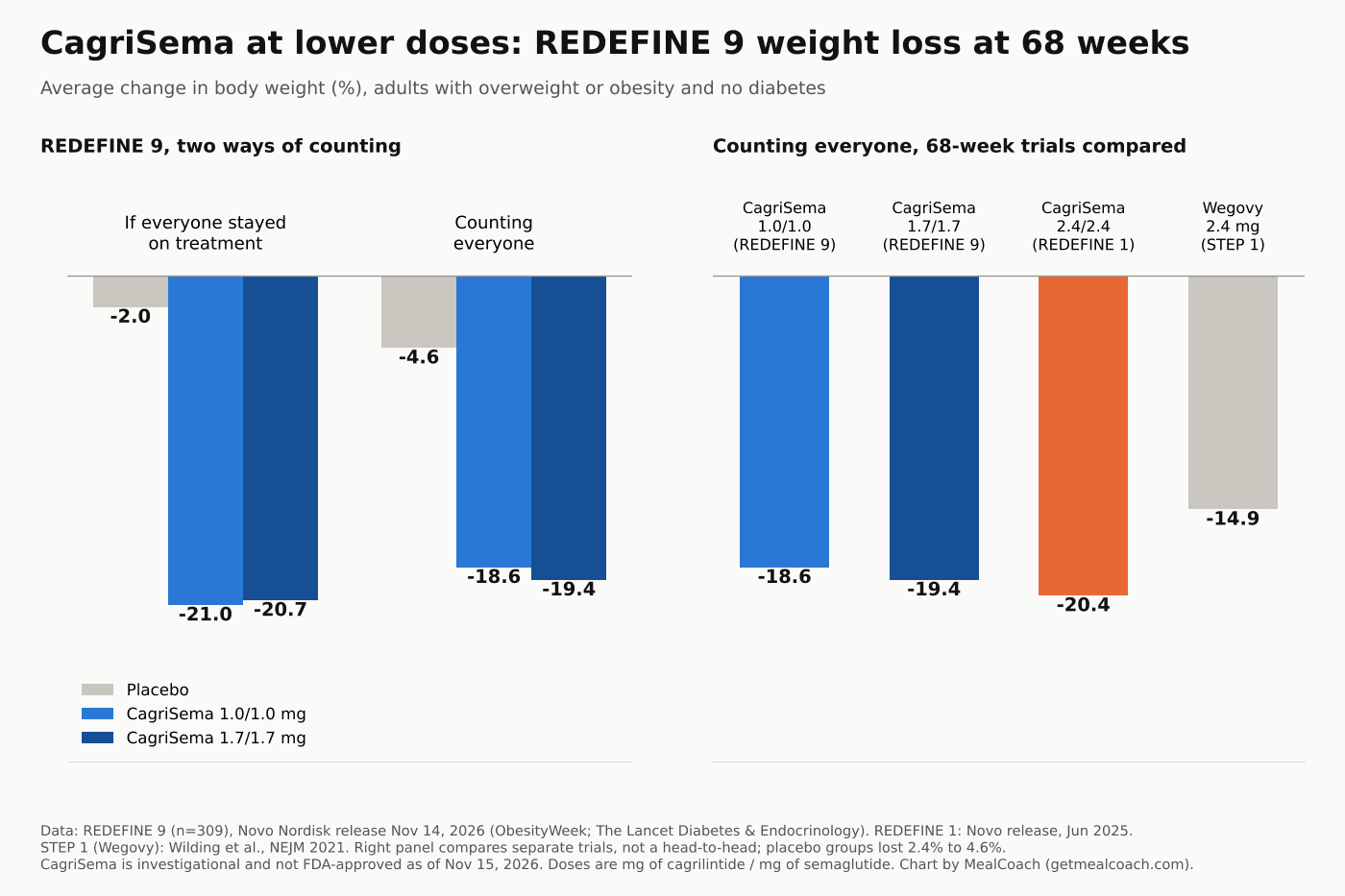
The short answer: Lower-dose CagriSema still worked. In REDEFINE 9, published November 14, 2026, people lost 18.6% to 19.4% of their weight in 68 weeks, versus 4.6% on placebo, counting everyone.
That’s close to the 20.4% the full dose managed in an earlier, much bigger trial. If everyone had stayed on treatment, the lower doses reached about 21%.
In this post you’ll learn what REDEFINE 9 tested, why there are two sets of numbers, how the lower doses compare with full-dose CagriSema and Wegovy, what’s known about side effects, and what this means while CagriSema waits on the FDA. About 7 minutes.
What Did the REDEFINE 9 Trial Test?
REDEFINE 9 tested two lower doses of CagriSema against placebo for 68 weeks in 309 adults with overweight or obesity and no diabetes. CagriSema is Novo Nordisk’s weekly shot that combines cagrilintide (an amylin drug) with semaglutide, the GLP-1 drug in Wegovy and Ozempic.
- Doses: 1.0 mg of each drug (written 1.0/1.0 mg) or 1.7 mg of each (1.7/1.7 mg). The full dose in earlier trials was 2.4/2.4 mg.
- Who joined: a BMI of 30 or more, or 27 or more with a weight-related condition. Average starting weight was 109.5 kg (about 241 lb).
- Groups: 103 people on 1.0/1.0 mg, 104 on 1.7/1.7 mg and 102 on placebo, per Securities.io’s summary of the release. Everyone also got diet and activity counseling, and Novo funded the trial, per the same summary.
The results were presented at ObesityWeek 2026 in Washington, D.C., and published the same day in The Lancet Diabetes & Endocrinology. It was not designed to tell the two CagriSema doses apart, only to compare each with placebo.
Action item: When you read about this trial elsewhere, check which dose a number belongs to. The 21% headline is the 1.0/1.0 mg dose, best-case counting.
How Much Weight Did People Lose on Lower-Dose CagriSema?
Counting everyone, people lost 18.6% on 1.0/1.0 mg and 19.4% on 1.7/1.7 mg, versus 4.6% on placebo, at 68 weeks. “Counting everyone” (Novo calls it the treatment-regimen estimand) includes people who stopped the drug or used other weight-loss help.
Novo’s headline uses a second way of counting, “if everyone stayed on treatment” (the efficacy estimand). On that basis the numbers were 21.0% on 1.0/1.0 mg and 20.7% on 1.7/1.7 mg, versus 2.0% on placebo, per RTTNews and Securities.io.
Here’s how many people hit common milestones:
- Lost at least 5%, counting everyone: 87.7% on 1.0/1.0 mg and 92.8% on 1.7/1.7 mg, versus 41.1% on placebo.
- Lost at least 20%, if everyone stayed on treatment: 48.3% and 51.3%, versus 2.7% on placebo.
- Waist: down 17.5 cm and 17.2 cm, versus 3.6 cm on placebo (about 6.9 and 6.8 inches, vs 1.4).
Why does the lower dose look slightly better one way and slightly worse the other? The gaps are small, the groups had about 100 people each, and the trial wasn’t built to compare the doses. The trial can’t tell whether one dose is better, so don’t read much into the gap.
Action item: If you’re comparing drugs, write down the “counting everyone” number for each. It’s the closer match to what happens in real life, where some people stop.
How Do the Lower Doses Compare With Full-Dose CagriSema and Wegovy?
Counting everyone, the lower doses lost about 1 to 2 points less than full-dose CagriSema and about 4 points more than Wegovy, in separate 68-week trials. Every number in this section uses the same “counting everyone” method.
- Full-dose CagriSema 2.4/2.4 mg (REDEFINE 1): 20.4% vs 3.0% on placebo, in 3,417 adults, per Novo’s June 2025 release.
- Lower-dose CagriSema (REDEFINE 9): 18.6% and 19.4% vs 4.6% on placebo.
- Wegovy, semaglutide 2.4 mg (STEP 1): 14.9% vs 2.4% on placebo, in 1,961 adults, per the NEJM paper as summarized by WikiJournalClub.
Notice the placebo groups differ (2.4% to 4.6%). Measured as the extra loss beyond placebo, the lower doses come out at about 14 to 15 points, versus about 17 for full-dose CagriSema and about 12 for Wegovy. REDEFINE 9 is also small, so its numbers are less precise.
My take: the news isn’t a better number. It’s that most of CagriSema’s effect seems to show up well below the top dose. That could matter for tolerability, if a lower dose is ever approved.
For how CagriSema stacks up against Lilly’s amylin combination, see CagriSema vs EloraTZP.
Action item: If someone quotes you a single “CagriSema loses X%” figure, ask which dose, which trial and which way of counting. You now know all three matter.
What About Side Effects?
Side effects were mostly stomach-related and mild to moderate, and few people quit because of them: 4.9% on 1.0/1.0 mg, 2.9% on 1.7/1.7 mg, and 4.9% on placebo. Those are the shares who stopped for good because of an adverse event, per Securities.io and BiotechReality.
Any adverse event was reported by 95% on 1.0/1.0 mg, 99% on 1.7/1.7 mg and 91% on placebo, per Securities.io. It also reports no deaths.
Two caveats. The coverage we could check doesn’t give nausea or vomiting rates by dose, so we can’t say whether the lower dose was gentler on the stomach. And in REDEFINE 1, 6.0% quit full-dose CagriSema for side effects versus 3.7% on placebo, but that was a different, much bigger trial.
Amylin drugs work partly by making you feel full sooner. If you want the background on that, see Amylin drugs explained.
Action item: If stomach side effects stopped you on a GLP-1 before, note that. It’s exactly the question to ask about lower doses once CagriSema’s label is public.
When Should You Call Your Doctor?
If you’re on any GLP-1 medicine now, call your doctor or care team promptly if any of these happen:
- Severe stomach pain that won’t go away, with or without vomiting.
- Vomiting or diarrhea you can’t keep up with, or signs of dehydration such as dizziness or very little urine.
- Pain in the upper right belly, fever, or yellow skin or eyes.
- Sudden vision loss or blurring in one eye.
GLP-1 labels warn about pancreatitis, gallbladder problems and dehydration (Zepbound’s, for example, per Lilly’s November 14 release), and on November 9 the FDA told makers to add a rare eye-condition warning to all of them; see the GLP-1 vision loss warning. In an emergency, call 911.
Action item: Save this list in your phone’s notes, next to your medicine list.
When Could CagriSema Be Available?
Novo filed full-dose CagriSema (2.4/2.4 mg) with the FDA in December 2025 and expects a decision in Q4 2026, per Securities.io. Novo’s third-quarter report says it is preparing for a US launch “in early 2027,” subject to approval, per the November 4 release.
As of November 15, 2026, the FDA hasn’t announced a decision. Novo hasn’t said whether the 1.0/1.0 or 1.7/1.7 mg doses will appear on a US label, or when. Price and insurance coverage are unknown.
Action item: If you’re waiting on CagriSema, ask your doctor what’s approved today. Don’t put off care for a drug that isn’t approved yet.
What Does This Mean If You’re on Wegovy or Ozempic Now?
Nothing changes today: CagriSema isn’t approved, and REDEFINE 9 didn’t test switching from Wegovy or Ozempic. It enrolled adults without diabetes and compared each CagriSema dose with placebo.
What it does give you is a better question for later. If CagriSema is approved, whether any lower dose is offered will depend on the label, which no one has seen yet.
Action item: Keep a simple log of your weight trend and side effects on your current medicine. If new options arrive in 2027, that record makes the conversation with your prescriber faster.
What We Don’t Know Yet
The big gaps are side-effect detail by dose, results in people with diabetes, and what the FDA will approve.
- Stomach side effects by dose: not in the coverage we could check. The Lancet paper should have them.
- Diabetes: REDEFINE 9 excluded it. CagriSema’s diabetes trials (REIMAGINE) are separate.
- Women, age and starting weight: no subgroup results were reported. For what’s known about women, see CagriSema in women by menopause stage.
- Beyond 68 weeks: no longer-term results yet.
- The label: which doses the FDA approves, if any.
Action item: Treat any per-dose side-effect claim you see this week with caution until the full paper is widely available.
Quick Answers
Does lower-dose CagriSema work? Yes, in REDEFINE 9. People lost 18.6% (1.0/1.0 mg) and 19.4% (1.7/1.7 mg) of their weight at 68 weeks, versus 4.6% on placebo, counting everyone.
Is the lower dose as good as the full dose? Close. Full-dose CagriSema lost 20.4% counting everyone in REDEFINE 1, a separate trial, so the gap is about 1 to 2 points.
Where does the “21%” come from? It’s the 1.0/1.0 mg result if everyone had stayed on treatment. Counting everyone, it was 18.6%.
Is CagriSema approved? Not as of November 15, 2026. Novo expects an FDA decision on the 2.4/2.4 mg dose in Q4 2026.
Does lower-dose CagriSema beat Wegovy? In separate trials, yes: about 19% versus 14.9% for Wegovy at 68 weeks, counting everyone. No head-to-head trial of these doses has reported.
What This Means for You
✅ You know lower-dose CagriSema cut weight about 19% in 68 weeks, counting everyone
✅ You know the 21% headline is the best-case way of counting
✅ You know the lower doses landed close to the full dose, in separate trials
✅ You know per-dose stomach side effects aren’t public in the coverage yet
✅ You won’t change any medicine based on a trial of a drug that isn’t approved
The 5-Minute Version (Screenshot This)
- The news: REDEFINE 9, a 68-week trial of CagriSema at 1.0/1.0 and 1.7/1.7 mg in 309 adults without diabetes, ObesityWeek and The Lancet Diabetes & Endocrinology, November 14, 2026.
- Counting everyone: 18.6% and 19.4% weight loss, vs 4.6% on placebo.
- If everyone stayed on treatment: 21.0% and 20.7%, vs 2.0%.
- Quit for side effects: 4.9% and 2.9%, vs 4.9% on placebo.
- Next step: FDA decision on the 2.4/2.4 mg dose expected in Q4 2026; Novo plans a US launch in early 2027 if approved.
Conclusion
Lower-dose CagriSema kept most of its punch. About 19% weight loss at 68 weeks, counting everyone, is close to the full dose and well above Wegovy in its own trial. The open question is tolerability by dose, and what the FDA will put on the label.
Your one action today: if you’re interested in CagriSema, bring this post to your next appointment and ask what’s right for you while it’s still under review.
So tell me: does a lower-dose option change how you think about these drugs?
Sources
- Novo Nordisk release: CagriSema REDEFINE 9, ObesityWeek 2026 and The Lancet Diabetes & Endocrinology (Nov 14, 2026)
- RTTNews: Novo reports REDEFINE 9 results (Nov 14, 2026)
- Securities.io: REDEFINE 9 design, results and safety (Nov 2026)
- BiotechReality: REDEFINE 9 at ObesityWeek 2026 (Nov 15, 2026)
- Novo Nordisk release via BioSpace: REDEFINE 1 in NEJM (Jun 2025)
- NEJM: Once-weekly semaglutide in adults with overweight or obesity (STEP 1, 2021) and WikiJournalClub summary
- Novo Nordisk Q3 2026 report (Nov 4, 2026)
- Lilly ObesityWeek 2026 release, including Zepbound label warnings (Nov 14, 2026)
 MealCoach