
“plateaued after approximately week 60 and was maintained for the remainder of the study”
The short answer: a GLP-1 plateau is expected, not a sign the drug stopped working. In the big trials of Wegovy (semaglutide) and Zepbound (tirzepatide), weight loss leveled off after about 60 to 72 weeks, then mostly held while people stayed on the drug.
An earlier stall is often normal weight swings, a starter dose, or slowly growing portions. Those are worth checking with your prescriber.
In this post you’ll learn when GLP-1 weight loss usually levels off, why the body puts on the brakes, how to tell a real plateau from normal weight swings, and what to bring to your prescriber. About 8 minutes.
When Does Weight Loss Plateau on a GLP-1?
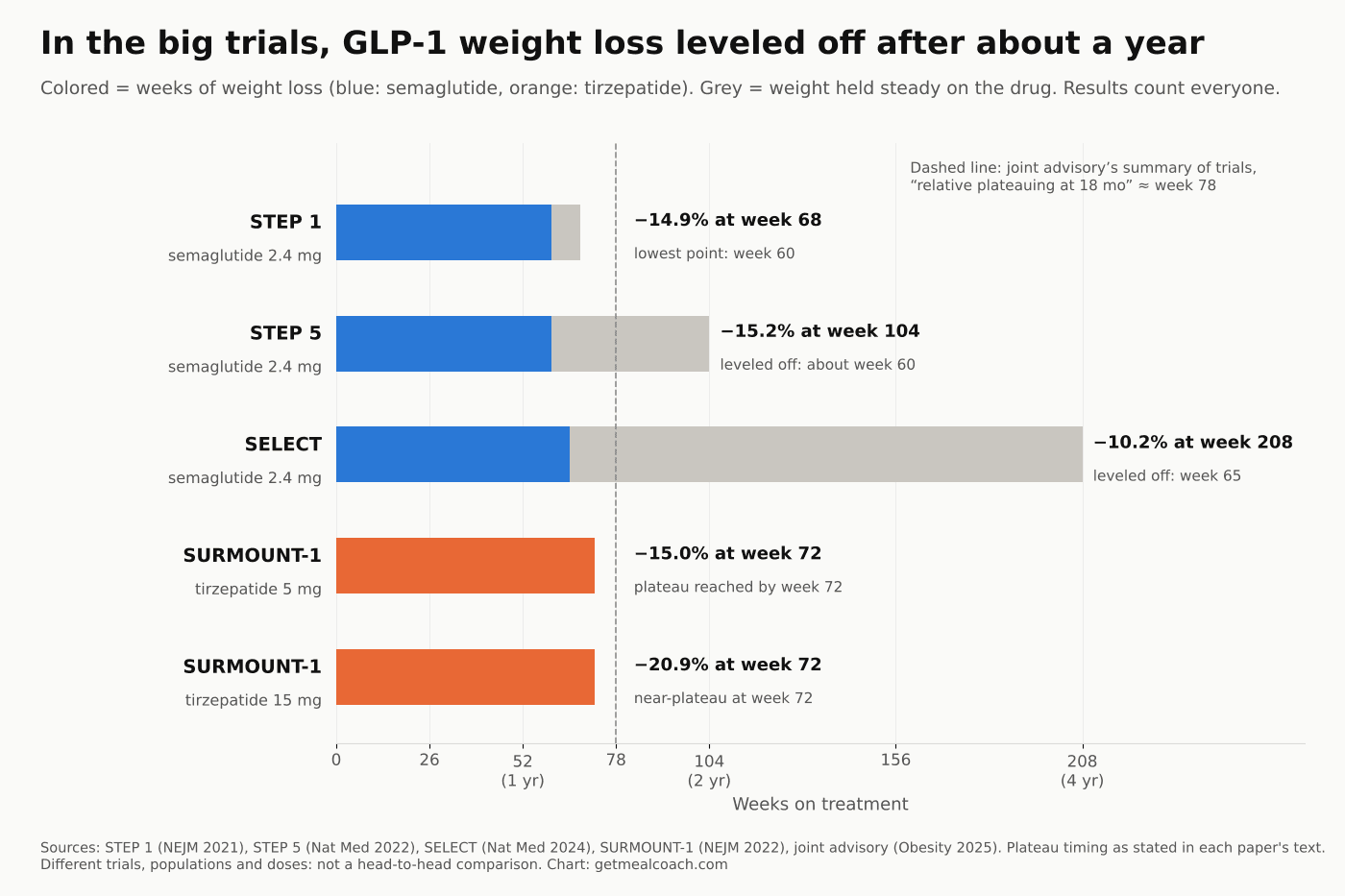
In the major trials, weight loss on a GLP-1 leveled off after roughly 60 to 72 weeks, a little over a year. Here is what each trial reported, counting everyone who started:
- STEP 1 (semaglutide 2.4 mg, the Wegovy dose): weight hit its lowest point around week 60. At week 68, people had lost 14.9% on average, versus 2.4% on placebo (Wilding et al., NEJM 2021).
- STEP 5 (semaglutide, two years): loss leveled off after about week 60 and held. At week 104, the average was 15.2%, versus 2.6% on placebo (Garvey et al., Nature Medicine 2022).
- SELECT (semaglutide, four years, 17,604 adults with heart disease): loss continued to week 65 and then held through week 208, at 10.2% versus 1.5% on placebo (Ryan et al., Nature Medicine 2024).
- SURMOUNT-1 (tirzepatide, the drug in Zepbound): at week 72, people lost 15.0% on 5 mg, 19.5% on 10 mg and 20.9% on 15 mg, versus 3.1% on placebo. The authors say the 5 mg group reached a plateau by then and the higher doses were near one (Jastreboff et al., NEJM 2022).
- SURMOUNT-1, three-year extension (1,032 adults with prediabetes): on tirzepatide, the loss was still 12.3% to 19.7% at week 176, depending on dose, versus 1.3% on placebo, counting everyone (Lilly release, Nov 2024; published in NEJM 2025).
Summing up the trials, a 2025 joint advisory from four obesity and nutrition societies says loss is fastest in the first 6 months, then slows, with a relative plateau around 18 months (Mozaffarian et al., Obesity 2025).
So if you’re more than a year in and the scale has gone flat, you’re probably right where the trials said you’d be.
Action item: Write down the month you started and your starting weight. How long you’ve been on the drug changes what a stall most likely means.
Why Does Weight Loss Stall on Zepbound or Wegovy?
Weight loss stalls mainly because appetite pushes back harder the more weight you lose, until it matches the drug’s effect. Your body burns a bit less as it gets smaller, too, but that part is smaller.
- Appetite rises as weight falls. In a study of 153 people on a diabetes drug that causes weight loss (canagliflozin, not a GLP-1), researchers including NIH’s Kevin Hall estimated that appetite rose by about 100 calories a day for every kilogram lost (Polidori et al., 2016).
- That push is bigger than the slowdown in calories burned. The same team found it was more than three times larger than the drop in energy your body spends.
- The plateau is where the two meet. Kevin Hall, then an NIH researcher, told CNN that the plateau comes when rising appetite matches the drug’s effect, and that a slower metabolism alone can’t explain the timing (CNN, via KTVZ).
That’s also why the plateau isn’t a personal failure. The drug is still working. It’s now holding the line against a stronger appetite. We cover why the body defends its weight in our summary of The Secret Life of Fat.
Action item: Notice whether your hunger has crept back compared with your first months. Telling your prescriber “I’m hungrier than I was” is more useful than “it stopped working.”
Is It a Real Plateau or Normal Weight Fluctuation?
A stall of a week or two is usually normal day-to-day swing, not a plateau. Body weight moves with water, salt, food in the gut and your weekly routine.
- In a study of 1,421 adults who weighed themselves often, weight followed a weekly cycle of about 0.35%, with the highest readings on Sunday, Monday and Tuesday (Turicchi et al., PLoS ONE 2020).
- A Finnish-led study of daily weights concluded that weekend-to-weekday swings should be treated as normal, not as weight gain (Orsama et al., Obesity Facts 2014).
Illustration, not a real person: on a slow week, someone losing 0.3 kg (about 0.7 lb) could see that loss completely hidden by a normal Monday bump of the same size.
A practical test before calling it a plateau:
- Weigh at the same time of day, on the same scale, after using the bathroom.
- Compare weekly averages, not single days.
- Look at at least four weeks of averages. This window is a common rule of thumb, not a number from the trials.
- Track one non-scale measure too, such as your waist. In SELECT, waist size fell 7.7 cm on semaglutide versus 1.3 cm on placebo by week 208.
Action item: Switch from daily numbers to a weekly average for the next month. Write each week’s average in one line of your notes app.
Are You Still in the Dose-Escalation Phase?
If you’re in your first few months, a stall may just mean you’re still on a starter dose. Both drugs start low and step up slowly, so early doses aren’t meant to deliver the full effect.
- Zepbound: starts at 2.5 mg a week for 4 weeks, then 5 mg. The label allows steps of 2.5 mg after at least 4 weeks on a dose, up to 15 mg. It tells prescribers to weigh treatment response and side effects when choosing the long-term dose (Zepbound label text).
- Wegovy shot: steps up monthly from 0.25 mg to 0.5, 1 and 1.7 mg, then a 1.7 or 2.4 mg maintenance dose (Wegovy label text). Since March 2026, the US label also includes a 7.2 mg dose (“Wegovy HD”) for adults who have tolerated 2.4 mg for at least 4 weeks and whose prescriber judges more weight loss is needed (HCPLive).
Neither label tells patients to change their own dose because of a stall. Whether a different dose, a different drug or no change makes sense is a conversation for your prescriber, who also weighs your side effects and health goals.
Action item: Write down your current dose and how many weeks you’ve been on it. Bring both numbers to your next appointment.
How Much Weight Loss Is Normal on a GLP-1?
There’s no single normal amount. Results vary widely from person to person, and real-world averages are lower than trial averages.
- In STEP 1, 86.4% of people on semaglutide lost at least 5% of their weight and 32.0% lost at least 20%, among those weighed at week 68, whether or not they were still taking it.
- In SURMOUNT-1, 91% on tirzepatide 15 mg lost at least 5% and 57% lost at least 20%, counting everyone.
- In everyday care, a Cleveland Clinic study of 7,881 adults without type 2 diabetes on semaglutide or tirzepatide found an average 1-year loss of 8.7%. People who never stopped lost 11.9%, and 80.8% were on lower maintenance doses (Gasoyan et al., Obesity 2025, via Drugs.com).
So a plateau at 10% isn’t the same as “the drug failed.” It may be close to your body’s current balance point on that dose. Your health markers, like blood sugar, blood pressure and how you feel, matter as much as the scale.
Action item: Work out your total loss as a percentage: pounds lost ÷ starting weight × 100. Compare it with these ranges instead of with someone else’s online.
What Can You Do During a GLP-1 Plateau?
During a plateau, the useful moves are the ones that protect your health and catch slow drift, not ones that chase the scale. Here’s what the evidence supports discussing:
- Protect muscle. In body-scan substudies, about 38% of the weight lost in STEP 1 was lean mass, per the joint advisory, and about 26% in SURMOUNT-1, per a 2026 review (Kim and Kim, Diabetes Metab J 2026). The advisory recommends strength training at least 3 times a week plus at least 150 minutes of moderate aerobic activity.
- Get enough protein. The same advisory suggests about 80 to 120 grams a day for many adults during active weight loss. Ask your care team what fits you.
- Check for portion creep. As appetite returns, portions can grow without you noticing. (Why GLP-1s make you feel full in the first place is in why you feel full faster on Zepbound.) Eating faster makes that easier, because fullness signals take time. Our guide to how to stop eating too fast explains why, and the free browser tool MealCam gives a gentle pace cue during a meal. It’s an awareness tool, not a weight-loss treatment.
- Talk to your prescriber. Bring your weekly averages, your dose history and any side effects. That’s enough for a real conversation about next steps.
My take: be wary of any “plateau-breaking” trick sold online. Nothing in the trials shows a hack that restarts weight loss on the same dose.
Action item: Pick one: two strength sessions this week, or one slower meal a day. Track it for two weeks alongside your weekly weight.
When Should You Call Your Doctor?
A plateau on its own isn’t urgent. Some changes that can come with GLP-1s need a call to your prescriber soon, and some need urgent care. The Zepbound and Wegovy labels list warnings including pancreatitis, gallbladder problems, and fluid loss from vomiting or diarrhea that can lead to kidney injury.
- Get urgent care for severe stomach pain that won’t go away (it may spread to your back), with or without vomiting.
- Call promptly for upper belly pain, fever, yellow skin or eyes, or clay-colored stools.
- Call promptly if vomiting or diarrhea won’t stop and you can’t keep fluids down.
- Call if you’re eating so little you feel weak or faint, or if a stall is making you think about skipping meals or doubling up.
Action item: Save your prescriber’s after-hours number in your phone today, before you need it.
Quick Answers
Does Zepbound stop working after a while? Not in the trials. In SURMOUNT-1, weight loss slowed and neared a plateau around week 72. In its three-year extension in adults with prediabetes, counting everyone who started, people on tirzepatide were still 12.3% to 19.7% lighter at week 176. Slowing down isn’t the same as stopping.
When does weight loss plateau on Ozempic or Wegovy? In the semaglutide trials STEP 1, STEP 5 and SELECT, weight loss leveled off around weeks 60 to 65. The 2025 joint advisory, summing up the trials, puts a relative plateau around 18 months.
I’ve been stuck at the same dose for weeks. Should I move up? That’s a decision for your prescriber. The Zepbound label allows a step up after at least 4 weeks on a dose, but it also says to weigh response and side effects first.
Why am I losing weight so slowly on Zepbound? Early doses are starter doses, and weekly weight swings of about 0.35% can hide slow progress. Results also vary a lot from person to person.
Can I break a GLP-1 plateau? No trial has tested a proven “plateau breaker.” Protecting muscle, checking portions and eating pace, and reviewing your plan with your prescriber are the evidence-based steps.
What This Means for You
✅ You know a GLP-1 plateau after about a year is expected
✅ You know why it happens: appetite pushes back as weight falls
✅ You can tell a real plateau from normal weekly swings
✅ You know what to bring to your prescriber: weekly averages, dose and timing
✅ You know which symptoms need a call, plateau or not
The 5-Minute Version (Screenshot This)
- Timing: in the big trials, loss leveled off around weeks 60 to 72, then mostly held while people stayed on the drug.
- Why: appetite rises as weight falls (about 100 calories a day per kg lost, in one analysis) until it matches the drug.
- Check first: weekly averages over at least four weeks, since weight swings about 0.35% within a week.
- Early stall: you may still be on a starter dose. Dose changes are your prescriber’s call.
- Next steps: strength training, enough protein, slower meals, and a review with your prescriber.
Conclusion
A GLP-1 plateau is the expected shape of treatment, not a verdict on you or the drug. In the trials, weight loss on Wegovy and Zepbound slowed and leveled off after about a year, and the drug kept doing its job by holding that loss in place.
Your one action today: start a weekly-average log and bring four weeks of it, plus your dose history, to your next appointment.
So tell me: when your weight loss stalled, what turned out to be behind it?
Sources
- Wilding JPH et al. Once-weekly semaglutide in adults with overweight or obesity (STEP 1). NEJM, 2021 (author copy)
- Garvey WT et al. Two-year effects of semaglutide in adults with overweight or obesity (STEP 5). Nature Medicine, 2022
- Ryan DH et al. Long-term weight loss effects of semaglutide in obesity without diabetes in the SELECT trial. Nature Medicine, 2024
- Jastreboff AM et al. Tirzepatide once weekly for the treatment of obesity (SURMOUNT-1). NEJM, 2022 (mirror)
- Mozaffarian D et al. Nutritional priorities to support GLP-1 therapy for obesity: a joint advisory. Obesity, 2025
- Polidori D et al. How strongly does appetite counter weight loss? (preprint of Obesity, 2016)
- CNN (via KTVZ): Here’s when your weight loss will plateau, according to science (Apr 2024)
- Turicchi J et al. Weekly, seasonal and holiday body weight fluctuation patterns. PLoS ONE, 2020
- Orsama AL et al. Weight rhythms: weight increases during weekends and decreases during weekdays. Obesity Facts, 2014
- Zepbound (tirzepatide) dosing, from the FDA label (Drugs.com)
- Wegovy (semaglutide) dosing, from the FDA label (Drugs.com)
- HCPLive: FDA approves higher-dose semaglutide (Wegovy HD 7.2 mg), Mar 2026
- FDA: Zepbound prescribing information, revised Feb 2026
- FDA: Wegovy prescribing information
- Lilly: SURMOUNT-1 three-year results in adults with prediabetes (Nov 2024; NEJM 2025)
- Drugs.com: real-world weight loss with semaglutide and tirzepatide (Gasoyan et al., Obesity, 2025)
- Kim and Kim. Review of body composition with GLP-1 therapy. Diabetes Metab J, 2026
 MealCoach