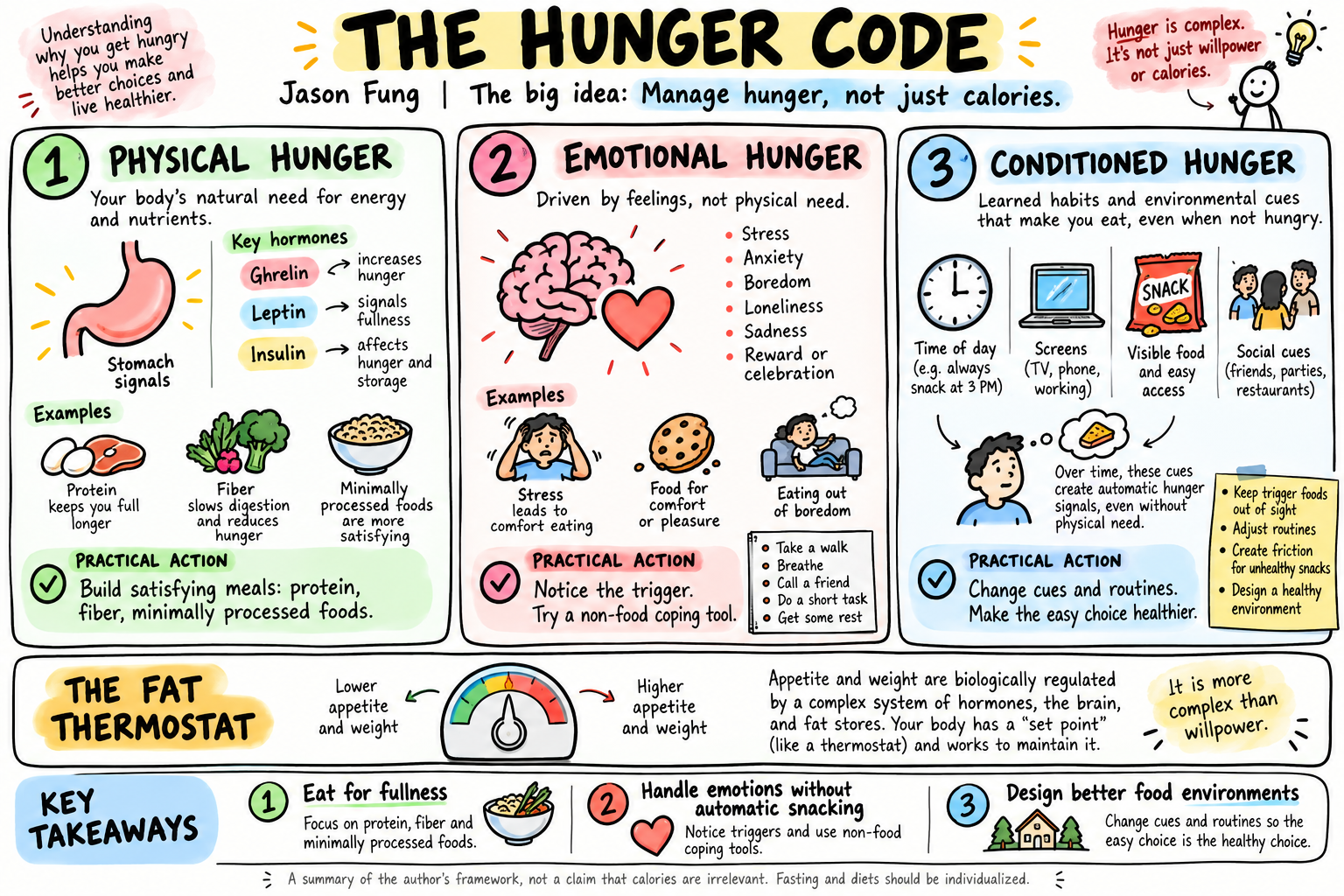
“cookies are more fattening than salmon”
The short answer: The Hunger Code (2026) is Toronto kidney doctor Jason Fung’s follow-up to The Obesity Code. He argues weight comes back because hunger, not willpower, runs the show. His three Golden Rules: avoid ultra-processed food, stop eating all the time, and build a healthy mindset and social habits.
You’ll learn the three kinds of hunger, the “fat thermostat” idea, what the studies say about fasting and GLP-1 drugs, and one small step to try today.
What Is The Hunger Code About?
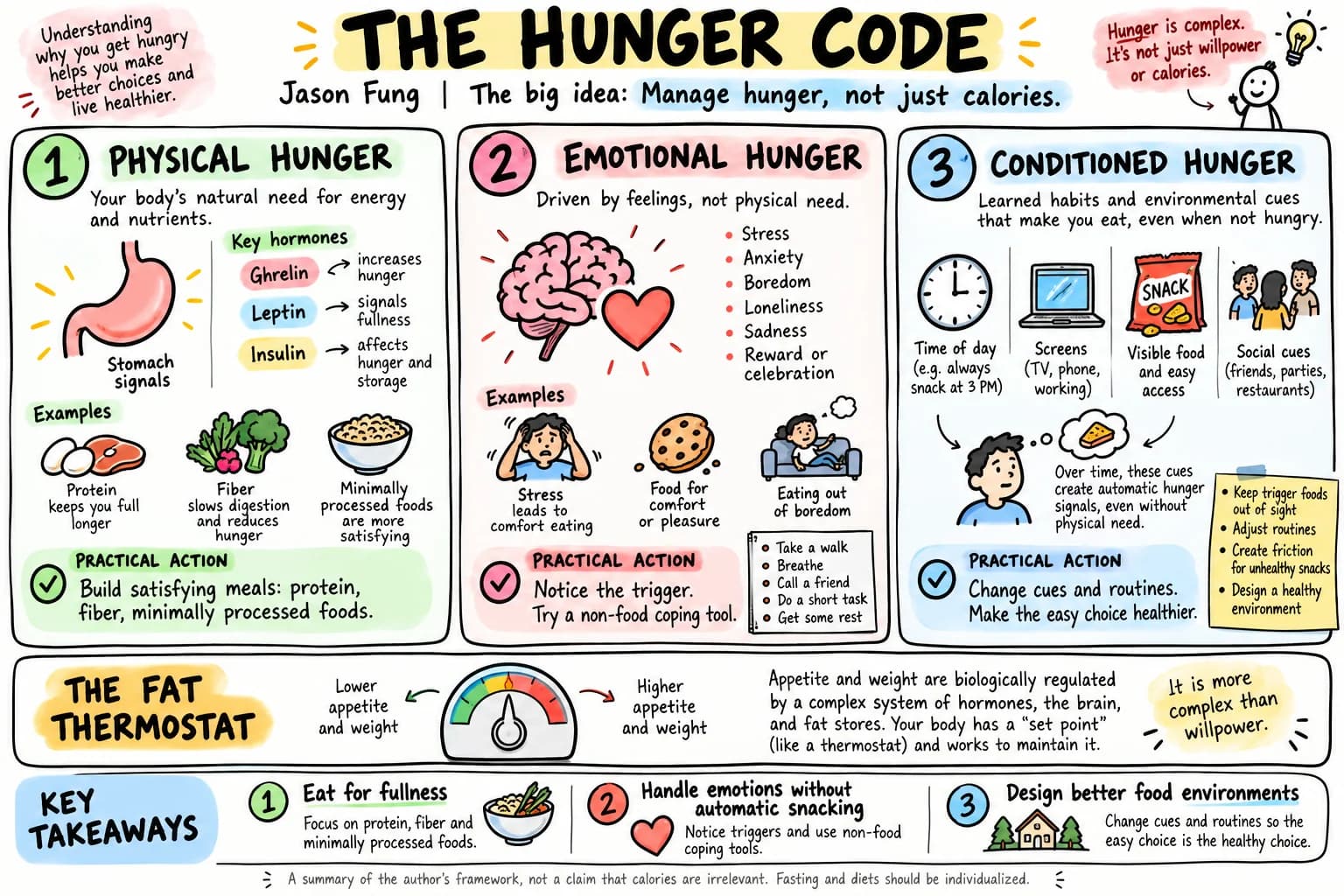
The Hunger Code asks why we eat, not just what or when, and says lasting weight control starts there. That’s the pitch from its publisher, Greystone Books, which released the hardcover on March 3, 2026, at 288 pages.
Fung is a nephrologist (a kidney doctor) and co-founder of The Fasting Method, a program for weight loss and type 2 diabetes. His 2016 book The Obesity Code sold millions of copies, Greystone says.
My take: that’s a better question than most diet books ask. “Eat less” is an answer. “Why am I hungry?” is a diagnosis.
Action item: Next time you reach for food, finish this sentence first: “I’m eating because…”
Why Does Weight Come Back After a Diet?
Fung’s answer is a “fat thermostat”: a set point your body defends with hunger and a slower burn when you cut back. Think of a home thermostat. Open a window, and the heat kicks on harder.
He recalled old overfeeding experiments on the Ben Greenfield podcast. Volunteers had to eat roughly 8,000 to 10,000 calories a day to gain 10% of their body weight, he said. When the feeding stopped, the weight came off again.
The other direction has better data. In a 2011 NEJM study, 50 adults started a 10-week very-low-calorie diet, and those who finished lost 13.5 kg on average. A year later, their hunger hormones still hadn’t gone back to normal. Leptin and PYY (fullness signals) were still low. Ghrelin (a hunger signal) was still high. And they still felt hungrier.
Regain isn’t a character flaw. Your body is fighting back.
Action item: If you’ve regained weight before, write down one thing that made you hungrier, not one thing you “failed” at.
What Are the Three Types of Hunger in The Hunger Code?
Fung splits hunger into three kinds: physical, emotional and social. On podcasts he uses the science names: homeostatic, hedonic and conditioned.
- Physical hunger is run by hormones like insulin, ghrelin, leptin and GLP-1. It’s your body asking for fuel.
- Emotional hunger is eating for reward, comfort or boredom. Ultra-processed snacks are built to hit this button.
- Social hunger (also called conditioned hunger) is habit and cue: the car, the TV, the office cake, the friends you eat with.
His clearest line on that third one, as Robert Lufkin reports it: “If your friends are eating salad, you eat salad.”
Action item: For one day, tag every snack: physical, emotional or social. Count which wins.
Why Does Fung Blame Ultra-Processed Food?
Because it drives all three kinds of hunger at once: it’s fast to digest, built to be rewarding, and everywhere. About 55% of calories eaten by Americans aged 1 and older come from ultra-processed foods, per a 2025 CDC data brief.
The best trial backs him up. In a 2019 NIH study, 20 adults ate about 500 more calories a day on an ultra-processed diet. They gained about 0.9 kg (2 pounds) in two weeks. “They also ate faster on the ultra-processed diet,” the NIH noted.
Fung adds texture. Blended or melt-in-your-mouth food digests fast and fills you less, he argues, because chewing helps signal fullness.
This is the part I agree with most. More on pace in how to stop eating too fast and food in our Ultra-Processed People summary.
Action item: Swap one soft, quick-to-eat food today for a chewier one: a whole apple instead of juice, oats instead of a cereal bar.
What Are the Three Golden Rules of The Hunger Code?
Rule one: avoid ultra-processed food. Rule two: don’t eat all the time, and fast regularly. Rule three: commit to a health mindset and healthy social habits. That’s the list as summarized by SuperSummary and in Fung’s talk with Lufkin.
- Rule one, in our reading, targets physical and emotional hunger.
- Rule two targets insulin and habit. Fung argues constant snacking keeps insulin up and trains your clock to expect food.
- Rule three targets social hunger: the people, places and routines around food.
Smaller tips: vegetables and protein before starch, whole fruit over juice, no screens. Stop at about 80% full (the Japanese habit hara hachi bu), per David Beruh’s review.
Action item: Pick the rule that’s easiest for you this week. Just one.
Is Fasting Better Than Cutting Calories?
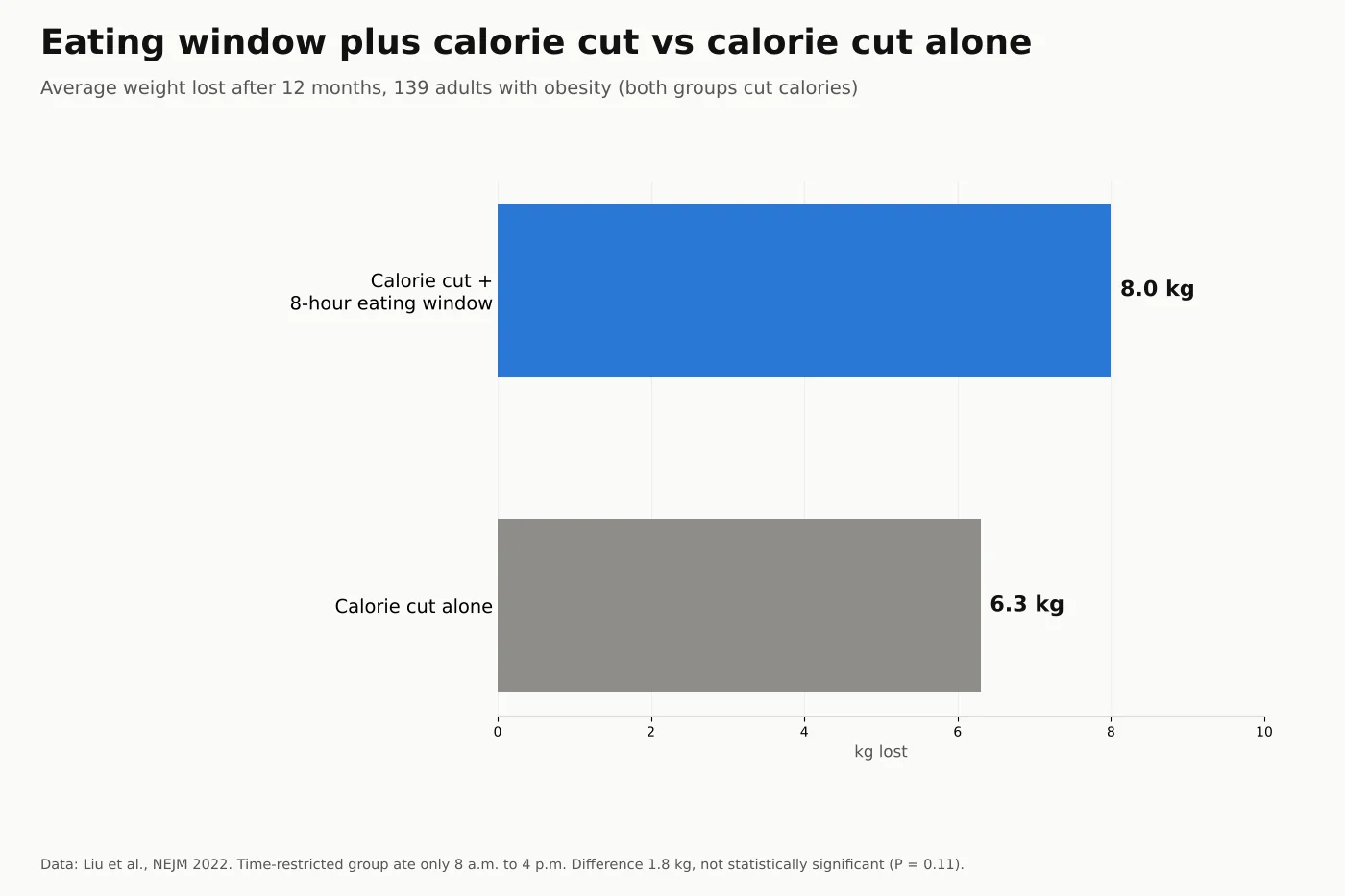
For weight, a major trial found an 8-hour eating window worked about as well as plain calorie cutting, not better. In this 12-month NEJM trial, 139 adults with obesity all cut calories. Half also ate only between 8 a.m. and 4 p.m. They lost 8.0 kg versus 6.3 kg, a gap the researchers called not significant.
So why fast? For some people, a clear “kitchen closed” time is easier than counting. Fair. It just isn’t magic, and if it makes you obsess about food, it isn’t your tool. For a stricter plan, see our Every-Other-Day Diet summary.
Action item: Try a “kitchen closed” time tonight, say two hours before bed. Note how you feel tomorrow.
What Does The Hunger Code Say About Ozempic and GLP-1 Drugs?
Fung isn’t against GLP-1 drugs, but he says most people on them never learn to manage hunger, so weight returns when they stop. He made that point on the Ben Greenfield podcast.
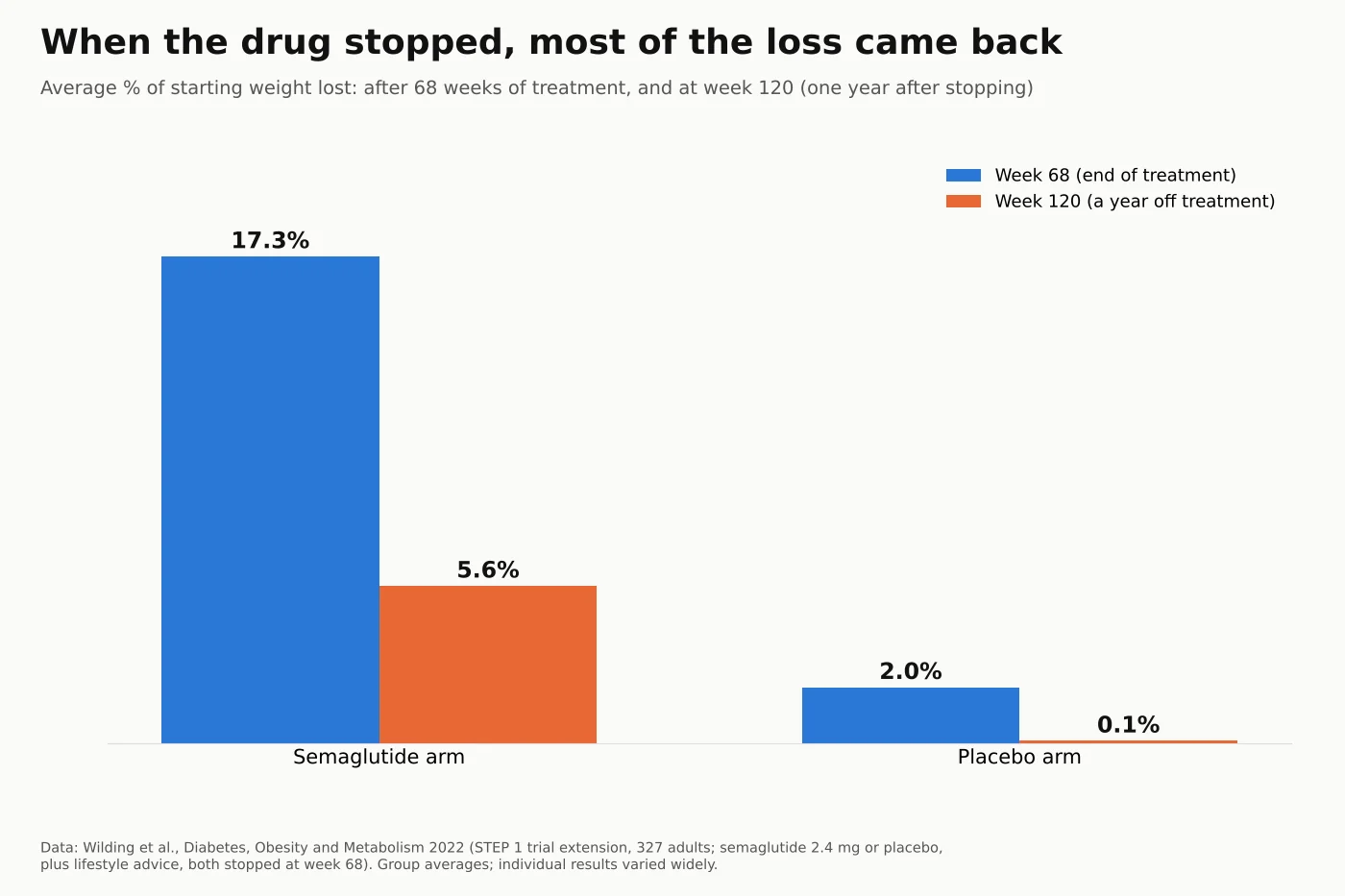
The regain data support his worry. In the STEP 1 trial extension, people lost 17.3% of their weight on average over 68 weeks of semaglutide. A year after stopping, they had regained about two-thirds of it.
My take: this is where the book earns its place. A drug can quiet hunger. It can’t teach you what to do when it gets loud again. We cover the drug side in our Magic Pill summary.
Action item: On a GLP-1? Ask your prescriber what your plan is for hunger if you ever stop.
What Does a Hunger Code Day Look Like?
A worked example (an illustration, not a meal plan from the book): one ordinary day run through the three rules.
- Breakfast: eggs and a whole orange instead of a cereal bar and juice. Rule one.
- Lunch: salad and chicken first, then the bread. Eaten away from the screen.
- 3 p.m. slump: name it first. Bored, not hungry? A short walk instead of the vending machine.
- Dinner: with family, slower, stopping at about 80% full. Rule three.
- After 8 p.m.: kitchen closed. Rule two, the gentle version.
Action item: Copy one line from that list into tomorrow.
Where The Hunger Code Falls Short
The practical advice is reasonable, but Fung’s central claim, that insulin is the main cause of weight gain, is disputed. “The insulin-as-the-primary-cause claim is overstated,” reviewer David Beruh wrote. He also argues calories still count.
The earlier book took heavier fire. Red Pen Reviews, with obesity researcher Stephan Guyenet as peer reviewer, scored The Obesity Code 1.2 out of 4 for scientific accuracy. It said “the book’s scientific claims should be read with skepticism,” though it called the diet generally healthy.
- Calories aren’t a myth. In the NIH trial above, the ultra-processed diet led to weight gain because people ate more.
- The fasting advice goes far. Some Goodreads readers worried that its advice to fast five to seven days at a time, repeatedly, looks like disordered eating. Others called the book repetitive.
Action item: Keep the habits, hold the theory loosely. Judge any change by how you feel after two weeks.
Why Is Everyone Searching for The Hunger Code Now?
Because millions of people are on, or coming off, GLP-1 drugs, and they want to know what keeps hunger in check afterward. In Google Trends, “the hunger code” and “hunger code jason fung” show as breakout searches (US, past 12 months, checked Oct 26, 2026).
Fung’s bet: understanding hunger is the skill that outlasts both the drugs and the snack aisle.
Action item: Write down the one food you reach for when you’re not really hungry. That’s where your own hunger code starts.
Quick Answers
What is The Hunger Code about? It’s Jason Fung’s 2026 book on why we feel hungry and how to keep weight off. It covers three kinds of hunger, a “fat thermostat” set point, three Golden Rules and 50 tips.
What are the three Golden Rules in The Hunger Code? Avoid ultra-processed food; don’t eat all the time and fast regularly; and commit to a health mindset and healthy social habits.
What is the difference between The Hunger Code and The Obesity Code? The Obesity Code (2016) focuses on insulin and when you eat. The Hunger Code adds why you eat: emotional and social hunger, ultra-processed food, and life during or after GLP-1 drugs.
Does The Hunger Code help after stopping Ozempic? It’s written partly for that reader, but it’s not a medical plan. Trials show much of the weight often returns after stopping, so make a plan with your prescriber.
Is The Hunger Code worth reading? Yes, if you want practical hunger habits. Read it alongside critics, because its insulin theory goes further than the evidence.
The 5-Minute Version (Screenshot This)
- The claim: weight comes back because hunger, not willpower, runs the show.
- The thermostat: after a diet, hunger hormones stayed shifted for at least a year in one NEJM study.
- Three hungers: physical, emotional, social. Each needs its own fix.
- Three rules: avoid ultra-processed food, stop eating all the time, and fix your mindset and social habits.
- Fasting: an 8-hour eating window was about as good as calorie cutting in a year-long trial, not better.
- GLP-1s: about two-thirds of the loss returned a year after stopping semaglutide in STEP 1.
- The catch: “insulin is the main cause” is disputed. Keep the habits, question the theory.
Conclusion
The Hunger Code is a better book than its theory. The insulin story is overstated. But the questions it trains you to ask are useful: am I hungry, or bored? Is this food filling me, or just pleasing me? Who am I eating with?
Those questions work on any diet, any drug, or none. And they’re free.
Your one step this week: before each snack, name the hunger. Physical, emotional or social.
So tell me: which of the three hungers trips you up most?
This is a book summary, not medical advice. Managing diabetes, kidney disease or a weight-loss medicine? Talk to your doctor before you fast or change how you eat.
Sources
- Greystone Books: The Hunger Code (hardcover, March 3, 2026), book and author details
- Ben Greenfield Life podcast: Reset Your Body’s Metabolism for Faster Weight Loss and Less Hunger, with Dr. Jason Fung (Feb 28, 2026)
- Robert Lufkin, MD: The Hunger Code with Jason Fung MD
- SuperSummary: The Hunger Code summary (the three Golden Rules)
- David Beruh: Book review, The Hunger Code
- Sumithran et al., NEJM (2011): Long-term persistence of hormonal adaptations to weight loss
- CDC NCHS Data Brief No. 536: Ultra-processed food consumption, Aug 2021–Aug 2023 (Aug 2025)
- NIH: Heavily processed foods cause overeating and weight gain (Hall et al., Cell Metabolism, May 2019)
- Liu et al., NEJM (2022): Calorie restriction with or without time-restricted eating in weight loss
- Wilding et al., Diabetes, Obesity and Metabolism (2022): Weight regain after withdrawal of semaglutide, STEP 1 extension
- Red Pen Reviews: The Obesity Code
- Goodreads: The Hunger Code reader ratings and reviews
 MealCoach