
“…substantial and clinically meaningful reductions in BMI…”
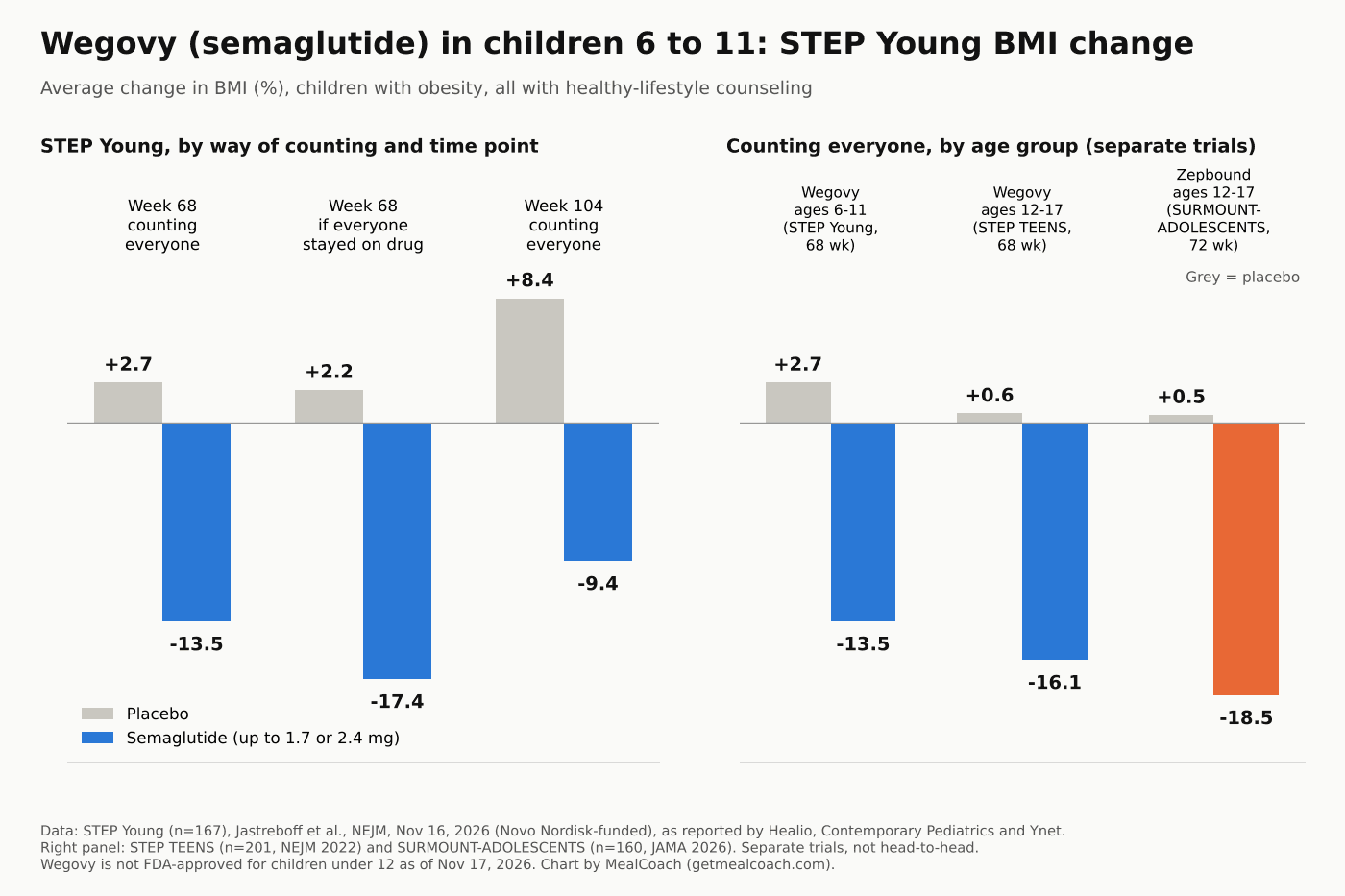
The short answer: Wegovy for kids aged 6 to 11 now has a full trial result. In STEP Young, published in NEJM on November 16, 2026, BMI fell 13.5% in 68 weeks on semaglutide versus a 2.7% rise on placebo, counting everyone.
About 4 in 10 children on semaglutide ended below the obesity cutoff. Vomiting was very common. Wegovy is still approved only from age 12.
In this post you’ll learn what STEP Young tested, why there are two sets of numbers, how it compares with the teen trials, what the side effects looked like, and what parents can do with this news today. About 8 minutes.
What Did STEP Young Test?
STEP Young compared weekly semaglutide shots with placebo in 167 children aged 6 to under 12 with obesity, for 104 weeks, with healthy-lifestyle counseling for every family. Semaglutide is the drug in Wegovy and Ozempic.
- Who joined: children with a BMI at or above the 95th percentile for their age and sex. Average age was 10, and 59% were girls, per Healio.
- How severe: more than 85% had class II or III obesity, the more severe end, per Novo Nordisk’s September 7 topline release.
- Groups: 112 on semaglutide and 55 on placebo (a 2:1 split), double-blind and in several countries.
- Doses: the top dose depended on weight: 2.4 mg for children over 60 kg, 1.7 mg for 45 to 60 kg, or the highest dose a child tolerated, per Contemporary Pediatrics.
- Who ran it: Novo Nordisk funded the trial. Novo says it was run to meet regulators’ post-marketing requirements for semaglutide.
The results were presented at ObesityWeek 2026 and published the same day in NEJM (Jastreboff et al.).
Action item: When you see a headline about this trial, check the ages and the timing: 6 to 11, main result at 68 weeks.
How Well Does Wegovy for Kids Work in STEP Young?
Counting everyone, BMI fell 13.5% on semaglutide and rose 2.7% on placebo at 68 weeks, a gap of 16.2 percentage points. “Counting everyone” (the treatment-regimen estimand, the trial’s main analysis) includes children who stopped the drug.
Novo’s headline figures, per Contemporary Pediatrics, use a second way of counting, “if everyone stayed on treatment” (the efficacy estimand). On that basis BMI fell 17.4% versus a 2.2% rise, a gap of 19.7 points, per Ynet’s report on the paper. Contemporary Pediatrics notes that several of the headline figures come from supportive analyses and should be read with caution.
Why BMI and not weight? Children are still growing, so doctors track BMI against age and sex charts.
Here’s what else moved:
- Below the obesity cutoff at 68 weeks: 38% vs 2%, counting everyone. Novo’s “40.4% vs 0%” is the stayed-on-treatment version.
- BMI down at least 10%: 74.7% vs 4.3% counting everyone, and 78.7% vs 0% if everyone stayed on treatment, per Ynet.
- Moved down at least one BMI category: 79% vs 23% in the main analysis, and 83% vs 23.5% if everyone stayed on treatment, per Ynet.
- Waist: down 8.5 cm (about 3 inches) vs up 2.7 cm, per Healio.
- Blood fats: triglycerides fell 26.3% vs a 0.4% rise, per Healio.
Action item: If you’re reading coverage, note which number it uses. 13.5% counts every child; 17.4% assumes they all stayed on the drug.
What Happened by Two Years?
At 104 weeks, counting everyone, BMI was down 9.4% on semaglutide and up 8.4% on placebo, a gap of 17.8 points. The gap between groups held, but the drop on semaglutide was smaller than at 68 weeks.
The reports we read don’t explain that change, so we won’t guess. After 104 weeks, children came off the drug for a 7-week washout, and BMI went back up in the semaglutide group, per Healio. Dr. Jastreboff said at ObesityWeek that 26 weeks of off-drug data are still to come.
Action item: Watch for the 26-week off-drug results. They will show what happens to BMI when children stop, which matters as much as the drop itself.
How Does It Compare With the Teen Trials?
Counting everyone, the 13.5% BMI drop in children aged 6 to 11 sits below the 16.1% seen with Wegovy in teens and the 18.5% with Zepbound in teens. These are separate trials in different age groups, not a head-to-head.
- Wegovy, ages 6 to 11 (STEP Young, 68 weeks): BMI −13.5% vs +2.7% on placebo in 167 children.
- Wegovy, ages 12 to 17 (STEP TEENS, 68 weeks): BMI −16.1% vs +0.6% in 201 teens, per the 2022 NEJM paper.
- Zepbound, ages 12 to 17 (SURMOUNT-ADOLESCENTS, 72 weeks): BMI −18.5% vs +0.5% in 160 teens; see our breakdown of the Zepbound teen trial.
Notice the placebo arms. Younger children on placebo gained more BMI (+2.7%) than teens did, so the gap between groups (16.2 points) is closer to the teen trials than the drug arm alone suggests.
My take: the news isn’t which number is biggest. It’s that a GLP-1 drug now has phase 3 results across childhood, from age 6 up.
Action item: If someone tells you a drug works “better” in kids or teens, ask whether the numbers came from the same trial and the same way of counting.
What About Side Effects in Kids?
Stomach side effects were the most common, mostly mild to moderate and more frequent while the dose was going up. Here’s what Healio reports from the paper for semaglutide vs placebo:
- Vomiting: 70% vs 29%. Diarrhea: 62% vs 35%. Nausea: 58% vs 24%.
- Any side effect: 96% vs 93%. Serious side effects: 9% in both groups.
- Stopped because of a side effect: 4% vs 2%.
- Mood and behavior: psychiatric side effects were reported in 21% vs 24%.
- Growth and puberty: Novo says no safety concerns were identified for growth or pubertal development.
Vomiting in 7 of 10 children is higher than the roughly half of teens who vomited on tirzepatide in SURMOUNT-ADOLESCENTS. Different trials again, but it’s worth knowing. For gut trouble in general, see GLP-1 constipation: why it happens and what experts advise.
Action item: If your child is on any GLP-1 medicine, keep a simple log of vomiting, missed meals and mood to bring to appointments.
When Should You Call Your Child’s Doctor?
If a child is on any GLP-1 medicine, call their doctor promptly if any of these happen:
- Vomiting or diarrhea they can’t keep up with, or signs of dehydration such as dizziness, a dry mouth or very little urine.
- Severe stomach pain that won’t go away, with or without vomiting.
- Pain in the upper right belly, fever, or yellow skin or eyes.
- New or worse low mood, or any talk of self-harm. If they are in danger, call 911; in the US, call or text 988 for crisis support.
- Sudden vision loss or blurring in one eye; see the FDA’s GLP-1 vision warning.
In an emergency, call 911.
Action item: Save this list in your phone’s notes, next to your child’s medicine list.
Is Wegovy Approved for Children Under 12?
No. As of November 17, 2026, semaglutide is “not approved in the United States for use in children under the age of 12,” per Novo Nordisk’s ObesityWeek release.
Wegovy has been FDA-approved for teens aged 12 and older with obesity since December 23, 2022, per Drugs.com’s approval history.
We found no announced FDA filing date for children under 12. Any timeline you see is a guess until Novo or the FDA says otherwise.
Action item: If you’re exploring options for a child, ask their doctor what’s approved for their age today, and why it would or wouldn’t fit.
What Does This Mean If Your Child Has Obesity Now?
Nothing changes today: Wegovy isn’t approved under 12, and every family in this trial also got lifestyle counseling. What it gives you is better information for a conversation with your child’s doctor.
It also helps to know that weight often returns after these drugs stop, in adults at least; see what happens when you stop a GLP-1. In STEP Young, BMI rose again within 7 weeks of stopping, per Healio; longer off-drug results haven’t been reported.
Action item: Keep a record of your child’s BMI percentile over time. It makes any future conversation about options faster.
What We Don’t Know Yet
The big gaps are what happens after the drug stops, longer-term growth, and what regulators will do.
- Off-drug results: BMI rose in the 7-week washout; the 26-week off-drug results haven’t been reported.
- The two-year dip: why the BMI drop was smaller at 104 weeks than at 68 weeks.
- Growth into the teen years: two years is short compared with a whole childhood.
- The full tables: we couldn’t open the paper, so details like who stopped and why come from news reports. Contemporary Pediatrics reports one child stopped because of stomach side effects; Healio reports 4% vs 2% stopping for any side effect.
- The label: whether, and when, Novo files for children under 12.
Action item: Treat any claim about long-term safety in young children with caution. This trial can’t answer it yet.
Quick Answers
Does Wegovy work in children aged 6 to 11? In STEP Young, BMI fell 13.5% in 68 weeks versus a 2.7% rise on placebo, counting everyone, in children with obesity.
Is Wegovy approved for kids under 12? No, not as of November 17, 2026. In the US it’s approved for adults and for teens from age 12.
Where does the “17.4%” come from? It’s the BMI drop if every child had stayed on treatment. Counting everyone, it was 13.5%.
What were the main side effects? Stomach problems: vomiting in 70% vs 29% on placebo, diarrhea in 62% and nausea in 58%. Most were mild to moderate.
Did it affect growth? Novo says no safety concerns were seen for growth or puberty in the trial. Longer follow-up hasn’t been reported.
What This Means for You
✅ You know semaglutide cut children’s BMI 13.5% in 68 weeks, counting everyone
✅ You know the 17.4% headline is the best-case way of counting
✅ You know about 4 in 10 children ended below the obesity cutoff
✅ You know vomiting was very common, and which symptoms mean calling the doctor
✅ You know Wegovy isn’t approved under 12, and no filing date has been announced
The 5-Minute Version (Screenshot This)
- The news: STEP Young, semaglutide vs placebo in 167 children aged 6 to 11 with obesity, NEJM and ObesityWeek, November 16, 2026.
- Counting everyone, 68 weeks: BMI −13.5% vs +2.7%; if everyone stayed on treatment, −17.4% vs +2.2%.
- Below the obesity cutoff: 38% vs 2%, counting everyone.
- Two years: BMI −9.4% vs +8.4%, counting everyone.
- Side effects: vomiting 70% vs 29%. Wegovy is approved from age 12 only; no filing date announced for younger children.
Conclusion
Wegovy for kids now has a phase 3 trial behind it: a 13.5% BMI drop in 68 weeks for children aged 6 to 11, counting everyone, and about 4 in 10 below the obesity cutoff. The costs were a lot of vomiting, and the open questions are what happens off the drug and what regulators will do.
Your one action today: if you’re a parent weighing options, bring this post to your child’s next appointment and ask what’s approved and right for them now.
So tell me: what would you want to know before a child in your family started a weight-loss medicine?
Sources
- Jastreboff AM et al. Semaglutide for the Treatment of Obesity in Children 6 to <12 Years of Age (STEP Young). NEJM, published online Nov 16, 2026. doi:10.1056/NEJMoa2604058 (paper not readable from our tools; figures checked against the reports below)
- Healio: Wegovy leads to “substantial” BMI decrease for children aged 6 to 11 years with obesity (Nov 16, 2026)
- Contemporary Pediatrics: Semaglutide cuts BMI 13.5% in children aged 6 to 11 with obesity (Nov 16, 2026)
- Ynet: Weight-loss drug Wegovy shows promising results in children as young as 6 (Nov 2026)
- Novo Nordisk release: STEP Young topline results (Sep 7, 2026)
- Novo Nordisk release: CagriSema and Wegovy at ObesityWeek 2026, including US approval status (Oct 29, 2026)
- Weghuber D et al. Once-Weekly Semaglutide in Adolescents with Obesity (STEP TEENS). NEJM 2022;387:2245–2257
- Drugs.com: Wegovy FDA approval history
 MealCoach